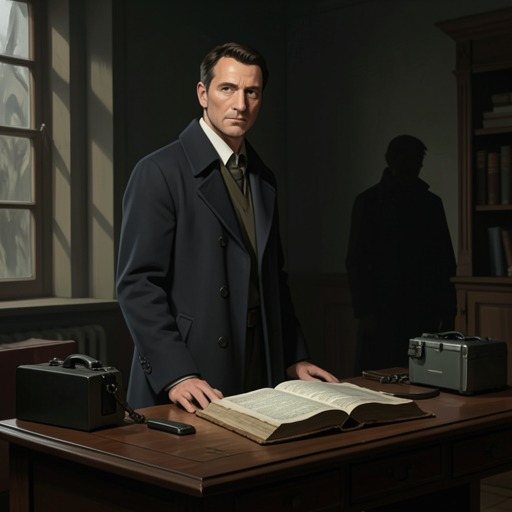
Thyrza Grey, who claims to cause distant deaths
The Pale HorseThyrza Grey, who claims to cause distant deaths, is introduced as the owner of the Pale Horse and as a woman whose occult interests give the old inn its unsettling character. Her study of witchcraft and the mind culminates in a theory of killing through suggestion: rather than directly harming a victim, she says, an operator can awaken a desire for death. Yet when Mark Easterbrook asks whether she can do this herself, she does not give him a direct answer, keeping the power she claims at the boundary between explanation and performance.
Identity and Introduction
Thyrza is identified by Rhoda as the person to whom the Pale Horse belongs. The building’s old inn sign, framed in its hall, offers an emblematic introduction to its association with her: an inherited-looking object displayed within a place that has become her domain. Hugh Despard characterizes her interests as spiritualism, trances, and magic, placing her among occult practices without identifying her with the more extreme rituals he mentions only as a comparison.
Mark first encounters her at the threshold. She is tall, dressed in a tweed coat and skirt, with short, rough grey hair, a high forehead, a prominent nose, and light-blue eyes that Mark finds penetrating. Her hearty manner of greeting the arriving party contrasts with the dark hall behind her, where another face peers out from the shadows. The description establishes Thyrza as a conspicuous presence at the entrance, while the partially seen figure in the hall lends the setting an air of concealment. The account gives no basis for identifying that figure with Thyrza or assigning it a role in her theories.
Occult Study and Intellectual Interests
Thyrza describes her interest in witchcraft and sorcery not as the result of a single formative incident but as a gradual absorption: an initially idle inquiry became a subject that held her. She is interested both in what people believed and in the foolish acts those beliefs could produce. Her remark makes the study double-edged. Occult practices attract her as a field of inquiry, but she also regards their history with skepticism about the conduct of those who practiced or accepted them.
When Mark asks what lies behind her interest, she turns from the history of belief to the capacities of the mind. Her explanation invokes the idea that a person can be made to die through suggestion, comparing the principle to practices used by medicine men in what she calls primitive communities. She insists that the process need not involve physically killing the intended victim. In her account, the crucial opportunity is psychological: the operator works upon a desire for death that she claims exists in everyone. These are Thyrza’s assertions, not independently established facts in the conversation.
Theory of Distant Influence
Thyrza argues that suggestion need not depend simply on a victim’s conscious belief in the operator’s power. When Mark proposes that such a method would work only if the victim believed in it, she answers that the modern world has advanced beyond the limits of the older model. She appeals to psychological knowledge as the means by which occult practice might be recast in modern terms, locating the supposed mechanism in the mind rather than in a visible physical attack.
The remaining problem, as Mark frames it, is how an operator could stimulate the death wish from a distance. Thyrza calls the means her secret and invokes communication without contact, drawing analogies with wireless, radar, and television. She also acknowledges that experiments in extrasensory perception have not progressed as hoped, but claims this is because investigators have failed to grasp the basic principle. Her confidence is strikingly specific in one respect: she says that what may happen accidentally could, once properly understood, be done reliably. The conversation, however, supplies no demonstration of the method.
Secrecy and Narrative Role
Mark tests the gap between Thyrza’s confident account and what she is prepared to disclose by asking whether she can perform the process. She does not answer immediately; instead, she moves away and tells him that he cannot expect her to reveal all her secrets. The hesitation leaves her capacity unresolved in this encounter. She presents a coherent-sounding theory, but her refusal to confirm her own ability prevents the discussion from becoming proof.
That uncertainty is central to Thyrza’s introduction. She can speak of the mind in terms that echo modern psychology and communications technology while retaining the language and atmosphere of occult practice. The framed inn sign, the dim hall, and her concealed method place her between visible explanation and unseen agency. Mark is therefore left with a claim to assess rather than a power he has witnessed: Thyrza is at once a practiced interpreter of occult ideas and a guarded figure who makes the limits of her knowledge part of her authority.